Friday, February 4, 2011

Poems For Wishing Tree

Service Level Management as a strategic tool

Author: Mag Eric Kaltman, Senior Consultant TEMA
Under the dogma "Entrepreneurial Security in Action" is a major focus of the management task in the application of an efficient methodology for implementation and ongoing management of strategic objectives at the operational level. In the posts on SRPI has already been discussed in detail on how strategically relevant performance indicators and identified as part of process optimization by using reference models can be improved. Today it is the efficiency of the SRPIs as service levels of internal (corporate) or outsourced services.

is what the strategic relevance of service level management:
  • service levels define the need-based design of services
  • service levels are a tool for cost control (lower service level = lower costs)
  • SRPI-correlating service levels provide a direct implementation of strategic objectives relevant
  • service levels (vs. cost) support strategic "make or buy decisions
  • The settlement model of services (which is included in the standard price, which is individual charged against it) affected the "consumption"
Which services and what organizational environment is service level management is an appropriate method

The focus of SLM is naturally in the environment of corporate Services (ie Central Purchasing, IT, Finance or Human Resources as a corporate service for several group companies) and as an indispensable element in the outsourcing of services. The idea may lie close to refer to their service levels and costs, for performance optimization of the performance of individual regions or departments, the authors argue, however, that is sufficient in such cases is usually the collection and benchmarking of individual SRPIs.

conditions and procedure for implementation:

The most important - and by many underestimated - a challenge for the implementation of service management is the definition of the service structure and the exact description of the content in these "products" included activities and related assets for service delivery. Suppose IT offers its service catalog is a product "standard workstation" at:
  • What hardware is provided renewed after how many years?
  • Which software licenses and annual maintenance fees for this are included? If
  • contain the associated Directory Server / File & Print servers and their support in the price?
  • Which assets for software distribution and call management are included?
  • What services are included in the standard price (eg help desk) which services are charged separately (eg IMACs - Install - Move - Add - Change) are
main design feature for us to structure the services have their market conformity, for it is a prerequisite for performance and price benchmarks in the industry as well as in the non-profit organizations (such as credits for funding bodies). The second design feature is the correlation with the SRPIs to ensure that these are projected correctly in a service. Here the experience of the respective division manager or consultant are required.

The process model in the figure provides an overview of the overall model:


Let's try an example representation of possible SRPIs for Central Purchasing: Adopted

they have in the company's strategic aims for purchasing the improve the economy of scale and reduction of lead times in the order process defined as targets, crowd as SRPIs almost on
  • The increase in purchase volume per active supplier (according to material groups)
  • The reduction in the number of active suppliers
  • The ratio (in%) of the active purchasing volume of master agreements
  • etc.
An increase in the volume of orders per order in contrast, could be counter-productive, because inducing the also increase the storage capacity and capital commitment.
Similar examples can be, for example. define for the improvement of delivery reliability, product quality or delivery time (ie typical SLs for purchasing) with ease. In addition to the action in the model as "operational SLs" defined indicators - mainly in our example the price of purchased materials and services - are the SRPIs a perfect service level based on the implementation of strategic objectives. Some service levels result also makes sense only if they are made in combination with others. Operational procurement costs as a percentage of purchase volume (the SL can be a good indication if there is no costing is implemented) are only meaningful when there is the same price as the amount of development information.

change management, SLA evaluation rules, Pönalevereinbarungen, escalation procedures etc., are essential components of the service level agreements. They regulate the procedures for any changes in requirements as well as the actions and consequences in the event of an error (broken down into levels of urgency).

the internal transfer model, the necessary external service prices are added to the internal activities (at least one "management shares" remains even with outsourced services companies) and charged on relevant quantitative indicators, via internal activity allocation on the performance relating cost centers and orders. A settlement of internal activity allocation is always preferable to a levy approach, because the former quantity-based PPP support and the pay in the absence of different distribution key for plan / actual does not allow meaningful analysis of plan-actual value deviation.

Friday, January 28, 2011

Blood Clots With Sudden Periods

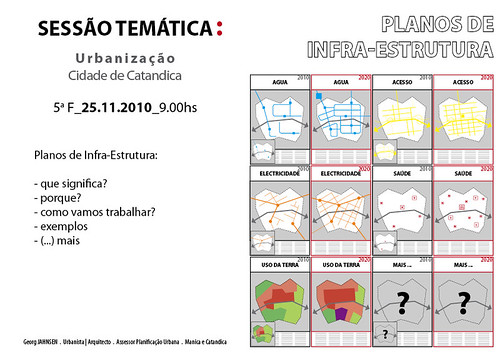
infrastructure plans - Planos de Infra-Estrutura

Planos de Infra-Estrutura

The plans of the city

In town planning, you can define three types of plans:
old plans, which represent the state of the city at an earlier date.
Current plans, which describe the current state of the city.
visionary plans that describe a desired state of the city in the future.

The main group, the relevant plans are for the city of the so-called infrastructure plans. The city planning makes a significant contribution to poverty reduction if the basic infrastructure the city will be improved.

The representation on existing infrastructure in the city points to the Government and the policy fields of action for the coming years. They are also an inventory list and a list of deficiencies. In addition, the plans of the situation now-old plans are added to the situation of 10 years ago. Sun current developments and achievements in the field of urban development will be made visible.

With these plans prior to sketch in the projected future developments. This infrastructure plan as a desired state in the future (eg 10 years) is called a master plan or strategic planning.


city's plans


In city planning, there are three types of plans: Plans
old, representing the state of the city earlier.
Current plans, which describe the current state of the city.
visionary plans that describe a desired state of the city in the future.


The core group of relevant plans for the city's plans are infrastructure. The city planning makes a significant contribution to poverty reduction, if the basic infrastructure of the city is improving.


The graphical representation of the existing infrastructure point to the government political fields of action for the coming years. These plans are also an inventory list and a list of deficiencies. In addition, the plans of the situation of age can now be added the plans of the situation 10 years ago. As this current developments and achievements in the field of urban development will be visible.


These plans can be designed as a basis of projected future development. These plans for infrastructure such as to desejado estado no futuro (por exemplo, 10 anos) é chamado estratégico plano.

Sunday, January 23, 2011

Watch Gamily Guy Online Ipod Touch

Continued: From business strategy to strategy compliant IT - activity planning

Author: Mag Eric Kaltman, Senior Consultant TEMA

Part 2: From IT strategy to IT strategy planning measures conforming


In Part 1 of the postings we finished with the thesis that optimum efficiency IT strategy can be achieved only if the action plans are for the individual IT departments in setting priorities consistent with the strategic objectives. The "optimum" Efficiency is derived not only by the high percentage of cover of the strategy measures, but particularly by the inclusion of strategic action at the operational level.

In practice, often hundreds of planned measures on compliance strategy and priority must be checked. A direct mapping of each activity against the SEPs and the IT strategy is doomed in the narrow sense only because of the complexity resulting from the "non-accountability" to fail. As a proven means of such a

allow mapping of measures, has the definition of so-called "category of actions" is presented, in turn, in which we are already known structure formed. Such categories allow subsequently a traceable weighting of the category of activities, which in turn can be easily assigned to each measure.

key to success is the appropriate definition of the categories of measures. They must not only be clearly possible to assign the IT SEPs, but also support in their development a different weighting for each category. The following examples illustrate this is:

Take the following in Part 1 of the article defined IT SEPs for the exemplary formulation:
A.
quality with a focus on availability and performance
b. Short development times


ad a.: quality has focused on performance and reliability in sealed structure particularly relevant to infrastructure measures and processes in operation and Development. Not everything that bears the "stamp" quality, but it should therefore be projected in the strategy for "high flyers". It therefore makes sense, for example. to define the following types of action for this SEP

• Infrastructure measures to protect the operation (Pri 1)
• Infrastructure measures to improve performance and stability (Pri 2) •
process quality assurance in development (Pri 3)
• Process SLA definition and reporting (Pri 4)

These categories of measures can then be weighted differently relatively simple: A measure to protect the operation - such as when a product runs out of maintenance - no doubt would have the highest priority, as would be the other way around. the preparation of a development manual does not equal a priori.

ad b.: Short development time:

Similar to the first example could also be the focus on infrastructure and processes:

• Infrastructure measures / tools for automated testing (Pri 2)
• Infrastructure Implementation Central Services (reuse) (Pri 2)
• Process Standardized development process model (Pri 3)
• Sourcing temporary measures for capacity expansion (Pri 1)
• etc ...

It is important to keep in mind that the definition of the category of actions is the strategy. It even does. no sense in the field of applications, a category of activities "Corporate rollout" to define where the IT strategy does not provide such, vice versa, such a category of action in the case of group projects almost indispensable because it generally in support of the corporate strategy of the highest priority. Here is more difficult to know how your IT manager or consultant in demand. Since most of the SEPs in a number of + - 10 (more than 15, it should not be) is to define, anticipate a prioritization of the SEPs in at least 2 categories

helpful. This is the prioritization of the action, a combination of SEP-priority and the efficiency of each category of action for the SEP. Around 10 up to 15 SEPs can be on around 30-35 of action and hundreds of planned measures "act", if necessary you can also bundle them according to subject.
you have entered the actions such as in MS Excel, you can assign the category of action to take on the weighting of the measures by formula and have the basis for further planning steps. In order to

the existing dependencies of the activities undertaken meet, it is recommended that dependencies from the beginning in the action plan to grasp with (such as a column "predecessor / successor"). Conflicting priorities can thus be resolved "manually". For the master planning, it is also recommended to group the issues to development plans, key projects and operational action plans. These can then be incorporated into the capacity planning of IT. Logically, is an annual review of the strategic planning activities in a timely manner prior to budgeting for next year.

Tuesday, January 18, 2011

Military Coupons For Edible Arrangements

From business strategy to strategy-compliant IT - activity planning

Author: Mag Eric Kaltman, Senior Consultant TEMA

Part 1: Of the business strategy to IT strategy


The derivation of the IT strategy from business strategy set as a basic principle, a matter of course, the standard practice shows, however, hardly examples of a convincing and-strategic priorities to the level of the action plans, or at least development and allow project plans. This is a consistent strategic penetration not only in terms of "manageability" of importance, but also as an operational tool for the individual IT teams in their planning activities. The integration of the "top down" approach to strategy development with the "bottom up" approach operational planning activities becomes a "turbo boost" for IT.

starting point of the IT strategy development are the strategic success positions (hereafter abbreviated as SEP) of the corporate strategy (the development is the same elsewhere - "Balanced Strategy" - received). To derive the IT SEPs in addition a potential analysis of IT systems is carried out on the one hand accounts for changes in the IT market, on the other hand, the existing internal potentials.


Examples of changes in the IT market had about topics such as cloud computing, Social Media / Web 2.0, high bandwidth available, open source products, Web Services / SOA, such as in software development or the emergence of Agile Development. . Internal potentials often give information on standardization and consolidation options with the cost of state and existing improvement

Examples of possible IT SEPs are:
  • quality with a focus on availability and performance in the operating
  • solutions for the automation of internal workings
  • developing the use of corporate synergies
  • Short development times
  • compliance with IT Security Standards
  • cost efficiency in operation
  • - house expertise (capacity and training) in defined key IT technologies
  • etc ....
from the IT SEPs then the IT scorecard objectives (if a balanced scorecard is in use) in coordination with the scorecard objectives of the company derived. This is done in the usual manner, with the scorecard quadrants "Products - Processes - HR - Finance. The products from an IT perspective, are primarily applications and the applications, underlying infrastructure, process structuring, standard IT process models are used, such as ITIL, for simplicity, we distinguish between Organization and management, development, operations, sourcing and service level management (this level is the experience, the best to define the IT strategy in the narrow sense) are from HR sheet under the terms of the IT strategy mainly training / development and strategic capacity management process . The Finzanzstrategie deals a hand with strategic issues such as buying vs.. Leasing, etc., but also issues such as billing model, tariff setting and of course the total cost management.

The resulting IT strategy in the narrow sense defined the basic principles of design and therefore the scope to achieve objectives. The main components are the same and correlating content (Using above structure): With


derived from the presence of SEPs IT strategy, or rather their contents in above-mentioned structure of the foundation for a business-compliant IT strategy has been laid. Without consistent transformation in the Master Plan and without traceable "integration" of the topics (such as ... Application development, infrastructure management, support) from the IT departments are, however, the optimal efficiency of the strategy will not be run. (This part 2 of the article, which will be posted asap) offers